Analyzing Blackjack Decision Trees in the Context of Mobile Platform Limitations and Opportunities
Written by Ben Hansen · May 17, 2026
Analyzing Blackjack Decision Trees in the Context of Mobile Platform Limitations and Opportunities
Blackjack decision trees map every possible combination of player cards and dealer upcards into recommended actions such as hit, stand, double, or split, and these structures continue to guide both recreational players and software developers. Researchers have long modeled the game as a branching system where each node represents a state defined by the player's total, the dealer's visible card, and the presence of pairs or soft totals. Data from industry reports show that mobile devices now account for over 60 percent of online blackjack sessions worldwide, which places new demands on how these trees are rendered and executed.
Core Structure of Blackjack Decision Trees
Decision trees for blackjack rely on combinatorial mathematics that calculate expected values for each action under standard rules including six-deck shoes, dealer stands on soft 17, and double after split allowed. A complete tree contains several hundred terminal leaves once all paths reach a resolution, yet the most frequently used subsets fit within basic strategy charts that players memorize. Academic studies published through university mathematics departments demonstrate that following these trees reduces the house edge to under 0.5 percent in optimal conditions, while deviations increase that margin measurably.
Mobile Screen and Input Constraints
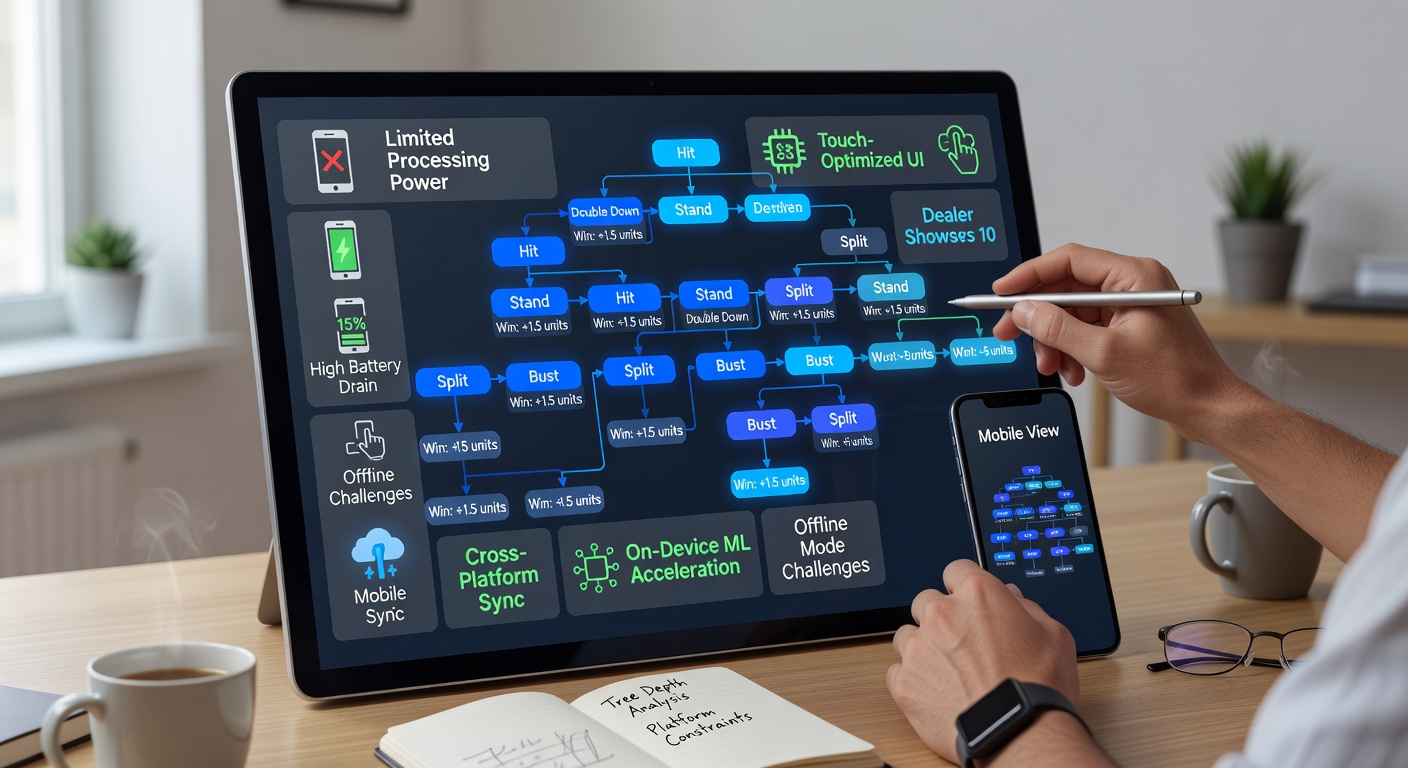
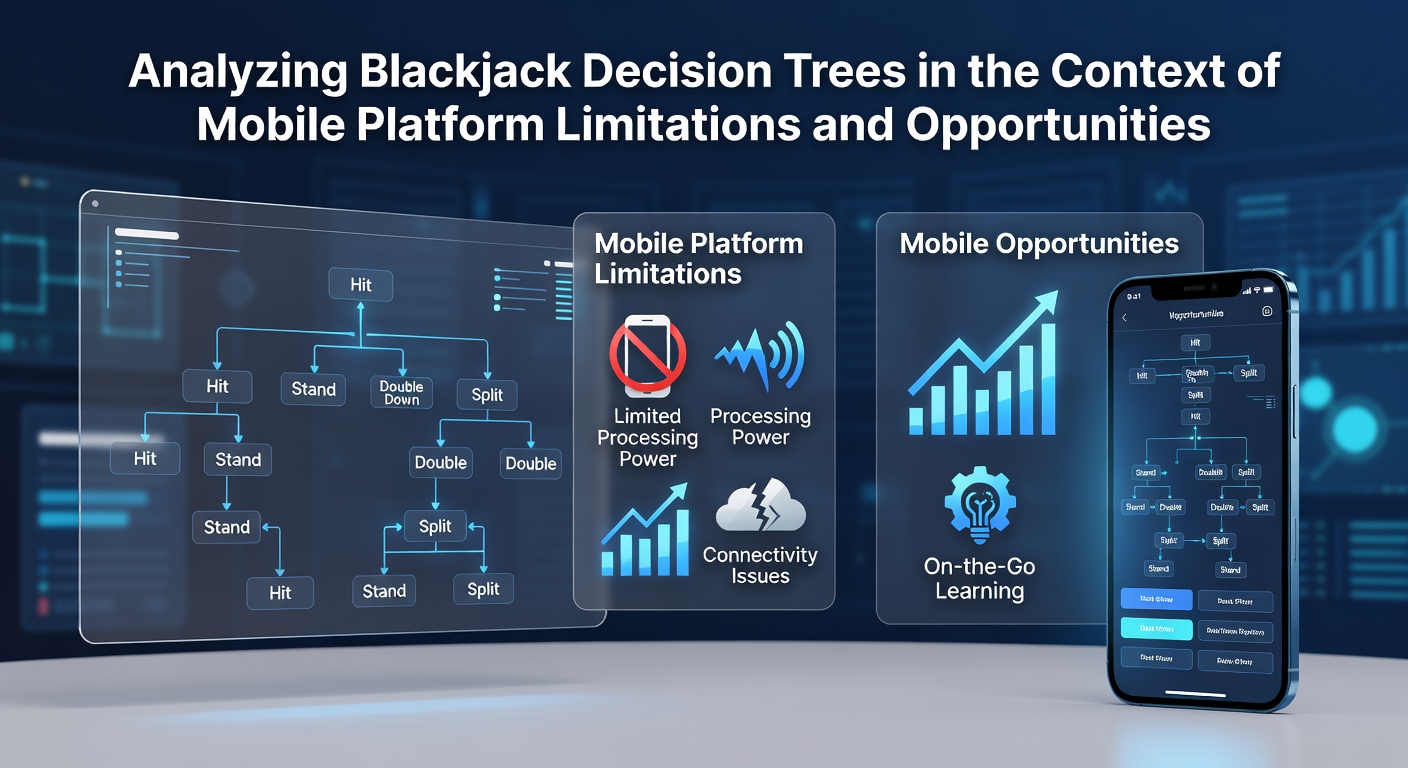
Smartphone displays typically range between 5.5 and 6.8 inches diagonally, which compresses the visual representation of a full decision tree into scrollable or tabbed views. Touch interfaces replace physical buttons, so developers implement larger tap targets and gesture-based confirmations to reduce mis-hits during live play. Battery and thermal limits further restrict continuous background calculations, forcing applications to cache pre-computed sub-trees rather than regenerate branches on every hand. Observers note that these hardware realities have prompted many operators to simplify tree navigation by highlighting only the top three recommended moves instead of displaying the entire structure at once.
Processing Power and Real-Time Computation
Modern mobile processors handle millions of operations per second, yet repeated Monte Carlo simulations of remaining deck compositions can still drain resources during extended sessions. Developers therefore pre-load core branches of the decision tree into memory and update only dynamic elements such as true count adjustments when card counting features are enabled. Research from European gaming technology labs indicates that optimized tree pruning techniques cut memory usage by 35 percent without altering expected value outcomes. As of May 2026 several major platforms introduced on-device machine learning models that predict player deviations from optimal paths and offer corrective prompts within 200 milliseconds of each decision point.
Opportunities Created by Portability and Connectivity
Constant network access allows applications to pull updated rule variations from remote servers so the same decision tree adapts instantly when a player switches from a Las Vegas Strip ruleset to a European single-deck variant. Location services further enable geo-specific compliance checks that disable certain features in regulated jurisdictions. Industry associations report that push notification systems now deliver micro-learning modules based on common decision tree mistakes, and players who engage with these modules show measurable improvement in adherence rates during follow-up sessions. Portable devices also support split-screen multitasking, letting users reference external count trackers or bankroll calculators alongside the primary game window.
Integration With Live Dealer and Hybrid Formats
Live dealer blackjack streams introduce additional variables because physical card delivery replaces electronic shuffling, yet the underlying decision tree remains identical once the upcard appears. Mobile cameras and augmented overlays now project optimal action arrows directly onto the video feed, reducing cognitive load for users who previously toggled between separate strategy screens. Data compiled by Canadian regulatory bodies tracking iGaming performance show that hybrid tables with embedded decision assistance retain users 18 percent longer than tables without such tools. Developers continue to refine latency compensation algorithms so that tree recommendations remain synchronized even when network jitter reaches 150 milliseconds.
Data Analytics and Personalization Trends
Application analytics track which branches of the decision tree players query most often, revealing patterns such as frequent second-guessing on soft 18 versus dealer ace. Aggregated datasets allow providers to surface context-aware tips that reference the player's historical error rate rather than generic advice. University-led research projects in Australia have explored reinforcement learning agents that simulate thousands of hands nightly on user devices during off-peak hours, then surface personalized tree modifications that align with individual risk tolerance levels. These approaches stay within memory and power budgets by limiting simulation depth to 50 hands per cycle.
Regulatory and Security Considerations
Jurisdictions including New Jersey and the Isle of Man require that any automated decision aid must clearly label itself as non-binding guidance so players retain full responsibility for choices. Encryption standards protect stored tree variants from tampering, while server-side verification confirms that displayed recommendations match certified rule sets. Security audits conducted in 2025 and early 2026 confirmed that on-device caching of decision trees does not introduce exploitable vulnerabilities when proper sandboxing remains active. Operators continue to publish transparency reports that detail update frequencies for mobile strategy engines across different regulatory markets.
Future Development Directions
Emerging foldable devices and higher refresh rate displays offer expanded canvas space that could render deeper decision tree visualizations without scrolling. Edge computing nodes positioned near major data centers now offload intensive probability recalculations, freeing local processors for smoother interface rendering. Cross-platform frameworks allow identical tree logic to run on both iOS and Android environments, reducing development duplication. Trade organizations tracking mobile entertainment metrics project continued double-digit growth in blackjack-specific app downloads through the remainder of 2026, driven largely by improved 5G coverage in secondary markets.
Conclusion
Blackjack decision trees remain mathematically stable even as delivery platforms evolve, yet mobile hardware imposes concrete constraints on visualization, computation speed, and energy consumption. At the same time, connectivity, touch interfaces, and machine learning create new avenues for real-time personalization and compliance enforcement. Data gathered through mid-2026 confirm that operators who balance these factors achieve higher session retention and regulatory alignment across diverse geographic regions. Continued refinement of tree representation techniques will determine how effectively players access optimal strategy while playing on the devices they carry every day.