Investigating Time Zone Influences on Participation Trends in Online Poker Tournaments
Written by Jordan Flores · Aug 14, 2026
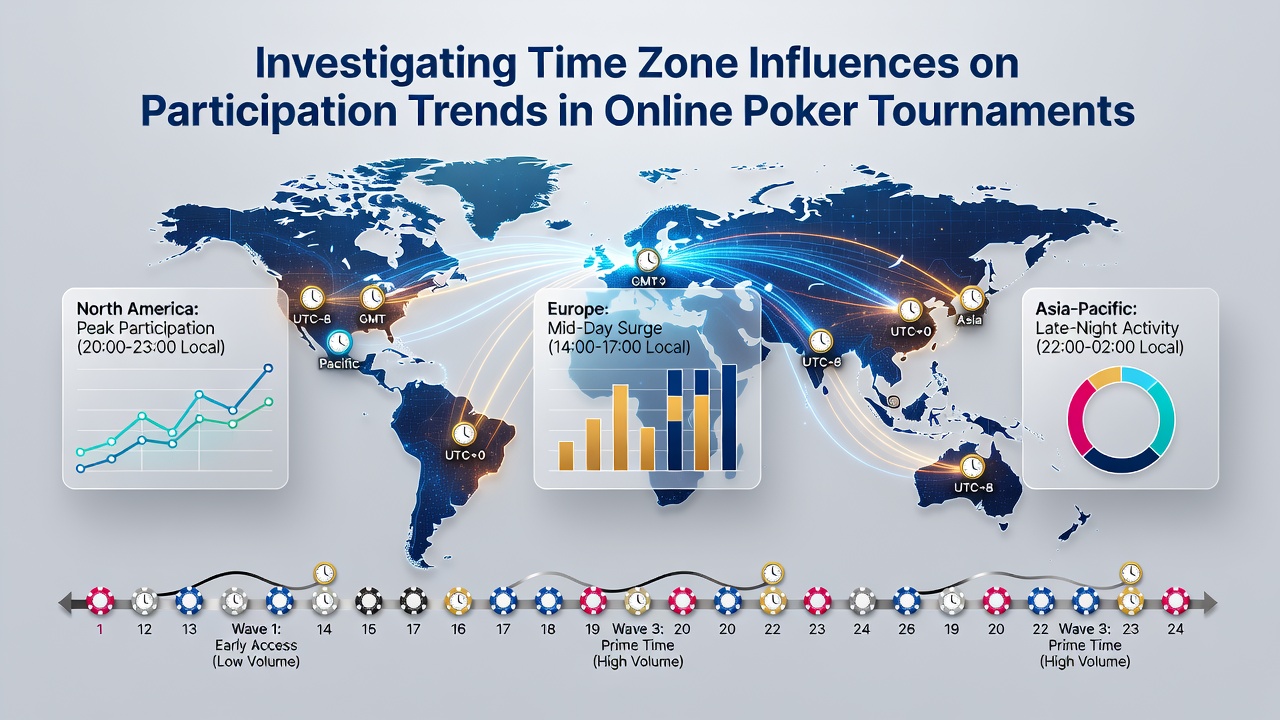
Investigating Time Zone Influences on Participation Trends in Online Poker Tournaments
Time zone differences create measurable shifts in when players join online poker tournaments, and operators track these patterns through registration timestamps and peak login data across multiple platforms. Researchers compile information from servers that record entries in coordinated universal time while players operate according to their local clocks, which produces clear regional clusters during evening hours in each market.
Regional Entry Patterns Across Major Markets
North American participants often register during late afternoon and early evening in eastern and central zones, whereas European players concentrate entries between 18:00 and 23:00 local time, and Asian markets show elevated activity after 20:00 in their respective zones. Data collected from large multi-site networks reveals that tournaments scheduled at 20:00 UTC attract the broadest mix of entrants from Europe and the Americas simultaneously, while those set at 12:00 UTC draw heavier participation from Asia and Australia. Observers note that these alignments appear consistently across monthly aggregates rather than single events.
Server Timestamp Analysis and Player Distribution
Platform operators convert all registration logs to UTC before comparing volumes, and this standardization highlights how a single start time produces different attendance levels depending on overlapping work and leisure periods in each geography. Studies that segment users by IP-derived location show higher completion rates when the start time falls within a player's typical evening window, yet lower retention when it collides with standard business hours. Figures from 2025 seasons indicate that a four-hour shift in start time can alter total entries by 15 to 25 percent in specific regions, though aggregate global numbers remain relatively stable.
Adjustments Observed in 2026 Scheduling
During August 2026 several major sites introduced staggered daily tournament grids that rotate start times every two weeks, allowing them to test participation elasticity across time zones. Early returns from these rotations show increased cross-regional overlap when events begin at 19:00 UTC, which aligns with post-dinner hours for both western Europe and eastern North America. Operators also adjusted satellite qualifiers to run earlier in the day for Asian time zones, resulting in higher conversion into main-event entries from those markets. Industry reports compiled by the European Gaming and Betting Association document similar experiments across multiple operators and confirm that modest scheduling tweaks produce repeatable changes in regional entry shares.

Impact of Daylight Saving and Seasonal Shifts
Twice-yearly clock changes in North America and Europe create temporary disruptions that platforms mitigate by publishing dual-time announcements, yet these transitions still generate short-term dips in certain time slots until players adjust routines. Australian participants experience minimal interference because their daylight saving period runs on an opposite schedule, which can create advantageous windows when northern hemisphere clocks shift. Research teams at the University of Nevada, Las Vegas Center for Gaming Research have tracked these seasonal variations through anonymized platform data and found that the magnitude of participation change correlates with the number of time zones crossed by the player base rather than the absolute start time itself.
Platform Features That Address Time Zone Friction
Many sites now display start times in both UTC and the user's detected local time, while some offer customizable notification settings that trigger reminders based on personal schedules. Mobile applications record device time zone settings at login, enabling operators to segment marketing campaigns and leaderboard displays by region without manual input. These adaptations have coincided with steady growth in multi-time-zone events that run across consecutive days, allowing players from distant markets to enter at their preferred hours within the same overall series.
Conclusion
Time zone alignment continues to shape entry volumes and retention metrics in online poker tournaments, with operators refining schedules based on aggregated timestamp evidence rather than anecdotal feedback. Continued monitoring of regional patterns through 2026 and beyond will likely produce further refinements in how platforms balance global accessibility against local player convenience.